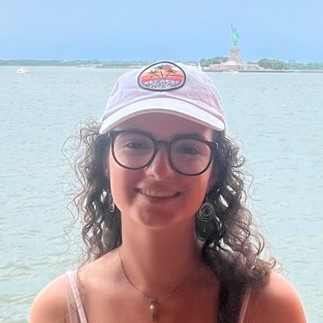
Hello!
I am currently a graduate student in Computational Linguistics at the University of Washington in Seattle, WA. I graduated from Western Washington University in June 2025 as the Outstanding Graduate in Linguistics with a BA in Linguistics, a BS in Mathematics/Computer Science, and a minor in Honors Interdisciplinary Studies. I grew up in Seattle but my heritage is Catalan and Argentinian, and I am a speaker of both Catalan and Spanish. I enjoy making art, solving puzzles, and traveling. During my time at WWU, I was a part of Dr Brian Hutchinson's Machine Learning Research Group, Drs Jordan Sandoval and Kirsten Drickey's Spanish Language Learning Research Group (LLRG), and Dr Maura O'Leary's Documentation, Analysis, and Revitalization in Linguistics Lab (DARLing).
Experience
Research for Intelligence & Security Internship
National Foreign Language Center (NFLC), University of Maryland
I built an LLM-powered content collection tool from scratch that gathers lesson content in seven languages, reducing manual collection time from hours to minutes. I integrated third-party APIs for LLM calling, web searching, text scraping, and audio transcription, and applied in-context learning and prompt engineering to improve the LLM's performance on classification and query generation. For accountability, the tool saves the output of every LLM call as a descriptive, human-readable record. I refactored the codebase for modularity so that future work can be integrated smoothly, and created a Gradio UI with instructions for entering the desired content specifications. Throughout the internship, I presented updates to other interns and leaders and addressed their questions and feedback.
Language Revitalization Tooling Research
University of Washington
I collaborated with other student researchers on langlit, a language revitalization app that addresses versatility gaps in previous tools. I performed user testing and documentation to improve the app's organization, built-in instruction, and overall user-friendliness, and I created tutorials for langlit users of different backgrounds, including documentary linguists, teachers, and learners. I co-authored a paper on this work, "Bridging Digital Tools for Linguistic Documentation and Revitalization", published in AmericasNLP.
Hutchinson Machine Learning Research Group
Western Washington University
I was part of a team creating a model to aid in the process of transcribing audio of toddler-adult interactions. I mainly worked with regular expressions, pandas, and forced alignment models. The team is collaborating with Dr Heather Moore from the Department of Speech, Language, and Hearing Sciences. In addition to working on my project, I attended weekly meetings, including a reading group, a tutorial given by a student in the group, and a status meeting where each team takes turns presenting on their progress.
Language Revitalization Lab
Western Washington University
I was part of Dr Maura O'Leary's lab, DARLing (Documentation, Analysis, and Revitalization in Linguistics). My work was focused on the revitalization of Hän, a severely endangered Athabaskan language with only five remaining speakers. I collaborated with other students on the morphological transducer team, significantly accelerating progress on what will become a translator. We analyzed and input Hän nouns and verbs into the transducer code, correcting errors to ensure translation function and accuracy. I maintained ongoing communication with students and faculty to share progress and challenges.
Language Learning Research Group
Western Washington University
I worked with Drs Jordan Sandoval and Kirsten Drickey to automate the Spanish LLRG's data organization. One step of the group's journey in improving the Spanish program at WWU was to design a Qualtrics survey to collect data from Spanish students. As my Honors Senior Capstone, I created a data formatting and plotting app that takes the data directly from Qualtrics and can do various tasks with it. Depending on the user's selections, the app can clean the data, create a scatter plot of the data with various customizable elements, or combine old data with new data into a single file. The link provides a user manual and artificial data so that anyone can try the app.
Projects
Arbitrarily Deep Neural Network
Pair programmed to implement a customizable neural network from scratch using NumPy and argparse. The NN supports both classification and regression tasks, handles minibatching, and has an optional verbose mode. It accepts data files, hyperparameters, and other settings through the command line for flexible experimentation. Based on the specified report frequency, the program evaluates the model on the development set and prints the performance.
Phoneme Classifier
I used Scikit-learn's MLPClassifier to create an ensemble model of twelve neural networks. Given vectorized audio inputs, the model classifies it as one of 61 phonemes using probabilistic voting. The four best performing NNs were given more votes, increasing ensemble model performance. I conducted extensive hyperparameter tuning and compared performance across model types. Details can be found in the report I wrote about this project.
Elizalike Chatbot
I designed regular expressions to identify and process personal deixis, covering all 1st and 2nd person subject pronouns as well as all forms of the verb be. I also implemented keyword recognition in the user input to trigger either a predetermined or partially input-dependent response, depending on the keyword.
WWU Scholars Week 2024
I collaborated with another student to conduct phonetic research in Catalan, under the advisement of Dr Jordan Sandoval. We designed a paragraph that contained various instances of our environments of interest, and had five native speakers record themselves reading the paragraph. Our poster was selected to be shown during Western Washington University's Scholars Week poster session, where my partner and I presented our work to various people, including students, professors, and other visitors.
Menstrual Cycle Tracker
This program populates and displays a calendar with given and predicted data, allows the user to input new data, and calculates expected next period and average length of period and menstrual cycle. I created additional functionality so that the calendar displays the recorded daily symptoms and intensity as color and size coded dots, providing easily readable and accessible information to the user. The user is able to have full control over their medical information, ensuring privacy.
Sentence Annotation GUI
I designed and implemented a GUI using Tkinter that allows the user to annotate sentences with advisement from Dr Sara Ng. The idea behind this project was to help with language revitalization. For low resource languages, synthetic data can be created in order for these languages to better benefit from language technology. This GUI provides an easy way for native speakers to annotate synthetic sentences and saves their input so that linguists can use that information in their revitalization work.
Zombie Videogame
I independently created a fully functioning zombie apocalypse themed text-based video game. It provides prompts and takes input from the player to determine the next step of the game, with some randomization. At each step, the player can choose from various actions, which may lead to new choices. The player statistics are updated after each action.
Blog Post
I independently did research on language technology for language revitalization and wrote this blog post on my findings. My goal was to investigate how language technology can help with language revitalization and what drawbacks it presents.
Alternations in Brazilian Portuguese
I independently researched phonological features in Brazilian Portuguese, using a grammar in addition to other resources and personal experience. I compiled my research into this paper, under advisement from Dr Jordan Sandoval.
Contact
UW email: anukz@uw.edu
Personal email: anukzc@gmail.com